
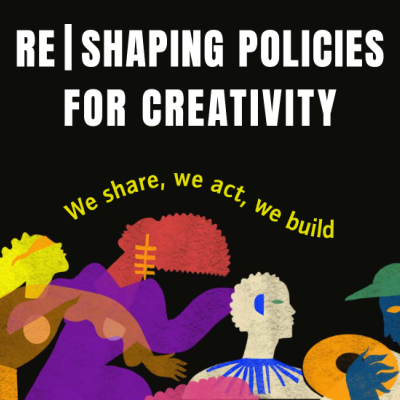
Reshaping Cultural Policy: Progress, Gaps and Persistent Inequalities
By Elena Politseva
UNESCO’s Reshaping Policies for Creativity 2026 report offers a comprehensive overview of global cultural policy trends under the 2005 Convention on the Protection and Promotion of the Diversity of Cultural Expressions. The findings reveal a complex picture: while formal recognition of culture in national frameworks is expanding, significant structural gaps persist between policy narratives and implementation. In several areas — from funding and mobility to artistic freedom and climate action — progress remains uneven and fragile.
Funding: convergence without sufficiency
Although developing countries have increased public spending on culture since 2018, the global average remains below 0.6% of GDP. Developed countries continue to allocate more than twice the share of GDP to culture compared to developing countries, even though their spending has largely stagnated or declined since 2014, with only a temporary increase during the COVID-19 pandemic.
At the same time, indirect public expenditure — particularly tax incentives — has become a dominant policy tool, especially in the audiovisual sector. The United Kingdom exemplifies this trend, where tax credits have expanded significantly since their introduction in 2007 and now exceed direct cultural ministry funding. While fiscal incentives can stimulate economic activity, they shift governments toward a market-facilitating role and are rarely assessed from the perspective of cultural public value. This raises important questions about the long-term balance between economic growth objectives and the protection of cultural diversity.
Mobility and global inequality
Global cultural mobility remains deeply unequal. A persistent “visa wall” restricts artists from the Global South. While 96% of developed countries support outward mobility, only 38% facilitate inward mobility from developing nations — a sharp decline from previous reporting cycles. Funding constraints further exacerbate this imbalance, with 67% of cultural organizations reporting direct impacts from financial cuts, particularly those working on human rights, democracy and gender equality.
These structural asymmetries limit the very international cultural exchange that the Convention seeks to promote and underscore the need for more reciprocal mobility frameworks.
Artistic Freedom: legal guarantees vs. reality
More than 90% of states report constitutional or statutory guarantees for artistic freedom. Yet violations are increasing. Strategic Lawsuits against Public Participation (SLAPPs) are being used to intimidate artists, while independent monitoring bodies have declined in some regions. Only 61% of countries report having independent bodies to monitor violations.
The digital environment presents further challenges. Despite rapid technological change, only 27% of developing countries and 19% of developed countries report specific measures addressing artistic freedom online. As generative AI reshapes creative production — with 79% of cultural professionals perceiving it as a threat — regulatory frameworks remain largely inadequate. Of 148 AI-related bills passed globally, only one identifies culture as its primary focus.
Culture and Sustainable Development
Culture is increasingly referenced in national development frameworks: 77% of countries now mention culture in their National Development Plans (NDPs) or National Sustainable Development Plans (NSDPs). More significantly, 56% now set specific cultural goals, up from 44% in the previous reporting cycle — a change largely driven by developing countries.
Yet evaluation remains limited. Only 25% of measures integrating culture into sustainable development frameworks have been assessed. Without monitoring and accountability, policy commitments risk remaining rhetorical.
Expectations regarding culture’s transformative contribution have also declined. The proportion of countries linking culture to environmental outcomes has fallen from 17% to 11%. Climate considerations remain weakly integrated into cultural policy frameworks, and the cultural and creative sectors are largely absent from national climate strategies. The culture–climate nexus continues to be addressed primarily through heritage preservation, rather than through broader engagement with creative industries and systemic transition.
Education, employment and structural shifts
Cultural policy is increasingly oriented toward creating jobs in the sector. Eighty-five percent of countries report job-creation measures in the cultural and creative sector, reflecting recognition of its economic weight. Interministerial cooperation increasingly involves ministries of education (28.1%) and trade or economy (25%).
However, the alignment between creativity and innovation policy remains weak. While 77% of countries acknowledge creativity and innovation in development plans, only 3% of interministerial measures involve innovation-focused agencies. In education, 83% of countries continue to offer university-level cultural programmes, and technical and vocational education and training (TVET) in cultural fields has expanded to 93%. Cinema, audiovisual arts and design have seen significant growth, particularly in vocational training. Yet arts and humanities graduates across OECD countries have declined by over 10% in the past decade, raising concerns about long-term knowledge ecosystems.
Civil society: consolidation and constraints
Civil society organisations in the cultural sector appear to be consolidating, with higher proportions of countries reporting professional bodies and trade unions across cultural domains. Eighty-six percent of Parties report providing training and mentoring to strengthen civil society capacity.
Nevertheless, a gap persists between consultation and meaningful inclusion. While 91% of Parties report consulting civil society in policy design, only 74% provide concrete examples of civil society-led measures. Financial pressures further constrain independent actors, especially those working in politically sensitive areas.
From narrative to action
Overall, the report suggests that cultural policy is at a crossroads. Institutional recognition of culture within development and governance frameworks is growing. Digital transformation is widely acknowledged. Decentralisation of cultural responsibilities has expanded. Yet the transformative potential of culture — particularly in areas such as environmental sustainability, artistic freedom in digital environments and equitable global mobility — remains under-realised.
The challenge ahead is not one of changing the rhetoric, but of advancing implementation. Turning formal commitments into enforceable protections, sustained funding and measurable impact will require stronger monitoring systems, cross-sectoral integration and political will. Culture’s role in sustainable development is widely acknowledged; ensuring that this recognition translates into durable structural change remains the unfinished task.