
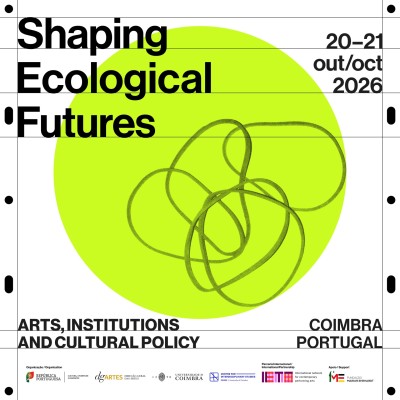
Shaping Ecological Futures: Arts, Institutions and Cultural Policy
On 20 and 21 October 2026, the International Conference ‘Shaping Ecological Futures: Arts, Institutions and Cultural Policy’ will take place, organised by the Directorate-General for the Arts (DGARTES) and the University of Coimbra through the Centre for Interdisciplinary Studies (CEIS20). The event aims to bring together artists, cultural workers, researchers and policy-makers for a critical reflection on the role of the arts and culture in the ecological and climate transition.
This initiative builds on previous collaborations between the two institutions in the field of sustainability in the arts and is particularly relevant at a time marked by an increase in extreme weather events, such as Storm Kristin, which affected central Portugal earlier this year. In this context, the aim is to reflect on the cultural dimensions of climate disruption and to imagine new forms of responsibility, governance, justice and care. How can the arts contribute to more active, situated and committed forms of participation in building ecological futures?
Taking into account the needs and specific characteristics of the cultural sector in Portugal, the conference programme, which brings together opportunities for listening, discussion and practical activities, explores how ecological engagement can reshape artistic production, institutional practices and cultural policies. At the same time, the initiative seeks to promote shared strategies and visions for the future, informed by current national and international debates and practices, in partnership with IETM – International Network for Contemporary Performing Arts.
Shaping Ecological Futures establishes itself as a platform for exchange, collective thinking and experimentation. By creating space for multiple perspectives and forms of knowledge, the conference aims to foster new alliances and inspire concrete strategies that are sensitive to different contexts, capable of integrating ecological awareness and practices into the cultural sector and beyond.