
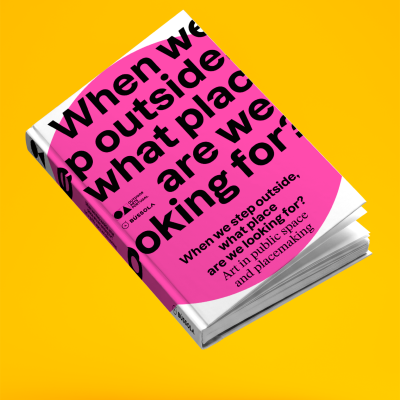
New Outdoor Arts Portugal publication challenges assumptions about culture, the city, and public space
When we step outside, what place are we looking for? proposes artistic creation as a tool to reimagine the urban context and to restore a political and participatory dimension to public space.
In a time marked by persistent territorial inequalities, accelerating ecological crises, and the erosion of traditional forms of civic participation, art in public space assumes an increasingly vital role in shaping fair, conscious, and sensitive urban futures. The book When we step outside, what place are we looking for? Art in public space and placemaking emerge within this context as a structural contribution to critical thinking and cultural action in the public realm. More than a collection of practices or essays, this publication represents a strategic and politically clear statement: a defence of artistic creation as an integral part of public policies for urban and cultural development, and as a mechanism for listening, mediation, repair, and collective imagination.
The work forms part of the Outdoor Arts Portugal sectoral development project, promoted by Bússola with the support of the Portuguese Republic - Directorate-General for the Arts. It is aimed at artists, programmers, municipal officers, urban planners, architects, researchers, and policymakers. In its bilingual edition (Portuguese/English), the book brings together national and international authors who combine practice, thought, and cultural action in public space. It coherently articulates a reflection on the concept of placemaking - often superficially or instrumentally appropriated - while proposing a situated, ethical, and critical vision that recognises the complexity of places, the diversity of their uses and memories, and the need for artistic practices deeply rooted in the social and spatial dynamics of each territory.
Here, placemaking is understood as a cultural and relational process, capable of regenerating feelings of belonging, activating community ecologies, and resisting hegemonic logics of urban planning. Far from being decorative or cosmetic, artistic practice in public space is presented as a political act - an act of active listening, situated co-creation, and sensitive transformation of everyday life.
Written by professionals with direct experience in urban development, artistic programming, curation, management, and research, the book reflects a deep understanding of the sector, its methodologies, and its challenges. From this experience arises a clear proposal for sectoral strengthening, anchored in an intersectional reading of territories and practices. Public-space creation is here defended as an artistic field with its own legitimacy, one that should not be subordinated to market logics or reduced to its capacity to generate immediate economic impact.
The book draws attention to the urgency of creating structural conditions for the sustainable development of this field: funding models compatible with long-term processes; recognition of its specificities within cultural policy frameworks; valorisation of mediation and critical participation; and effective integration into sustainable urban development policies.
The publication addresses a broad professional and institutional audience - artists, curators, programmers, researchers, municipal technicians, urban planners, architects, cultural managers, policymakers, and all those working at the intersection of culture, public space, and territorial transformation. It offers practical tools for designing integrated public policies and deepening cultural practices aligned with the needs and aspirations of communities. It explores key concepts such as spatial justice, expanded dramaturgy, the right to the city, symbolic repair, co-responsibility, and radical listening, shaping a contemporary lexicon that allows for a renewed understanding of cultural action in the public realm from a shared and operative foundation.
Politically, the publication stands as a manifesto in defence of culture as an infrastructure of democracy, of public space as a common good, and of art as a relational, critical, and transformative force. It rejects narratives that instrumentalise art for urban rebranding or gentrification, and proposes a vision in which artistic creation is understood as an essential part of building fairer, more caring, and more liveable cities. The book also warns against the fetishisation of participation, the limits of symbolic mediation without structural commitments, and the need to protect artistic processes from political or economic capture.
The title When we step outside, what place are we looking for? functions both as a provocative question and as a horizon for action. It invites readers to see public space not as a site of consumption or transit, but as a territory of symbolic dispute, civic exercise, and shared construction. From that question, the book builds an invitation to informed, critical, and collective action: for cultural policies committed to people and territories; for support structures that value time, care, and listening as central dimensions of artistic work; and for a more plural, equitable, and socially engaged cultural sector.
The publication also contributes significantly to current European debates on culture and the city. At a time when stronger articulation between cultural agendas and sustainable development goals is needed, this book offers a model of thought and action capable of informing local governance strategies, international cooperation networks, European funding programmes, and participatory urban regeneration projects. It highlights practices developed outside major centres, in the interstices and margins, recognising the value of decentralisation, intersectoral dialogue, and experimentation. It also reaffirms the role of artistic creation in public space as a valid tool for activating connections, making the invisible visible, and collectively reimagining what public space can be.
Grounded in extensive field experience - in curatorial practice, sustained programming, community participation processes, and international artistic cooperation - the book not only reflects on what has been done, but also projects pathways for what can and should be done. It thus stands as a strategic document to support public decision-makers, cultural promoters, mediators, and training institutions in shaping more coherent, equitable, and effective policies, programmes, and practices.
The preface is written by Charles Landry, recognised internationally as a leading voice on urban creativity and author of the concept of the creative city, whose work has influenced cultural and urban policies worldwide. His text opens the book with a clear call for political imagination and the centrality of care in contemporary cities.
Among the invited authors:
- Jamie Bennett, former Executive Director of ArtPlace America (USA), writes about people-centred culture and the impact of artistic investment in communities.
- Karine Décorne, co-founder of Migrations (Wales), reflects on artistic curation in rural and non-metropolitan contexts.
- Rachel Clare, founder of Crying Out Loud (UK), offers an essay on risk, discomfort, and transformation in artistic creation in public space.
- Ramon Marrades, urbanist and director of Placemaking Europe, contributes a text on the future of placemaking as a critical practice.
The editorial coordination was led by Bruno Costa and Daniel Vilar (Bússola), who also contribute their own texts exploring the intersections between placemaking and art in public space. The publication further includes contributions from Sud Basu and Tiago Mota Saraiva, and closes with a postface by Luís Sousa Ferreira, one of the most influential voices connecting culture and territorial development in Portugal.
As a whole, When we step outside, what place are we looking for? is a clear affirmation of art as a public and transformative act - a tool for critical reflection and sustained sectoral action. It stands as a proposal for those who believe that culture is a right and a common good, and that public space, far from being a given, is a territory that must be continually cared for, debated, and reimagined.
The publication will be available for free download.
Portuguese version HERE.
English version HERE.