
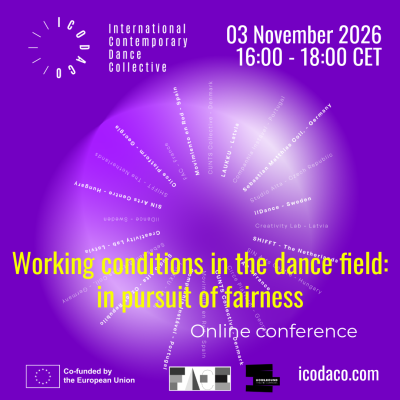
iCoDaCo online conference "Working conditions in the dance field: in pursuit of fairness"
The third iCoDaCo conference, “Working conditions in the dance field: in pursuit of fairness”, will take place online on Tuesday, 3 November 2026 from 16:00 to 18:00 CET.
The online event is organised by FACE, in collaboration with HowlRound.
How to register
Registration for the conference is free and open to all. To secure your place, please register via this link. Upon registration, you will receive a Zoom link automatically.
For any questions or accessibility requests, please contact: Yohann Floch, [email protected].
---------------------------------------------------------
This online conference brings together dance artists, choreographers, researchers and cultural practitioners to examine the specific circumstances in which contemporary dance is practised, produced and presented. It considers how the field is absorbing a broader crisis of disinvestment across Europe, and how that crisis compounds existing and unresolved inequalities. Working conditions in the sector remain markedly uneven from one European context to another: access to unemployment insurance, health cover, pension contributions and minimum fee levels varies considerably.
Changing funding conditions across Europe have been reshaping artistic practice from within. As public funding schemes increasingly attach conditions to how projects are conceived, reported and justified, artists must adapt their proposals, timelines and even their working methods to requirements that originate outside their artistic intentions. Practitioners describe this as a quiet form of self-censorship, narrowing what is proposed, and to whom, in order to fit what limited and conditional resources allow. What is presented in policy language as flexibility or agility can, in practice, function as a form of attrition. This is compounded by a broader shift in what funding is designed to support: a move away from funding the production and touring of finished work towards funding artistic "practice" in the abstract, at the very moment when that practice has itself become the primary currency by which artists are asked to justify continued support. The effect, several practitioners argue, is a gradual erosion of collective artistic work – ensembles, companies, shared production structures – in favour of individualised practices that are easier to fund in small increments but harder to sustain, harder to pass on, and harder to build a career or an institution around.
These funding pressures interact directly with the structure of dance education and with the shape of a dancing career. Dance schools across Europe graduate substantial numbers of young practitioners each year who are seldom absorbed into stable employment as dancers, but are instead expected, often immediately, to become choreographers and independent entrepreneurs, frequently without the business skills, administrative support or capital that this transition requires. Funding schemes compound the difficulty by concentrating support on early-career artists, leaving comparatively little available once that initial window closes, and considerably less for practitioners with two or three decades of experience.
This unevenness falls hardest on those already structurally disadvantaged, including migrant artists, LGBTQIA+ practitioners, artists with disabilities, and others whose access to stable status, residency or recognition is already constrained. Social and cultural justice for underrepresented communities cannot, in other words, be separated from the question of working conditions: the two compound one another, and any credible European response has to treat them together rather than in parallel. To speak of a shared European cultural space while such disparities persist is to speak of an unfinished project. Fairness, understood in this way, is not an abstract value to be affirmed but something to be built, tested and defended differently in each national and institutional context – and this applies equally to the many arts and cultural workers, beyond performers alone, whose administrative, technical and organisational labour sustains the sector and too rarely enters the policy conversation.
Dance artists and cultural professionals responding to unfairness
The distance between prevailing policy ambitions and daily practice, however, is precisely where this conference positions itself, and where the principles of solidarity, transparency, sustainability and responsibility – articulated, for instance, in the Juist is Juist charter developed in Flanders – become practical rather than rhetorical questions.
Solidarity, in this context, is less a sentiment than a working method: it concerns whether collaborators are conscious of how their own choices – over budgets, credits, schedules – shape the position of others in a project, and whether fair compensation and a safe working environment are treated as a collective obligation rather than a matter for each individual to negotiate alone. Transparency follows closely: it asks whether all parties to a collaboration have equal access to information about a project's resources and constraints, and whether the value attributed to each contribution is made explicit rather than assumed. Sustainability, meanwhile, concerns whether the collaborations and bodies of knowledge that a project generates are able to outlast the project itself, and under what institutional conditions that becomes possible. Responsibility, finally, asks whether partners genuinely understand and value the risks and commitments each is taking on, at every level of a collaboration, or whether that understanding remains one-sided. None of these can be secured by good intentions alone: each depends on frameworks, funding conditions and institutional habits that currently vary enormously across Europe, and it is this variation, rather than any lack of goodwill within the field, that the conference sets out to interrogate.
The conference poses an important question alongside the diagnosis above: how might artistic practice itself, precisely because it is formed in response to contextual constraints, come to inform cultural policy rather than simply respond to it after the fact? It also asks how dance artists engage with the broader question of social and cultural justice within their own working practice, treating this not as a separate concern but as inseparable from the question of fair working conditions itself. Ultimately, the conference aims to foster critical dialogue on the sector's capacity to address these disparities directly, and to draw out recommendations that could support a fairer and more consistent baseline for artists and arts workers across European cultural cooperation.
For more information about the structure of the conference and line-up of presenters, visit the iCoDaCo website here